

Trade shows remain one of the most effective ways to build business relationships. Whether you are a founder seeking partnerships, a sales representative building pipeline, a marketer generating demand, or a business traveler attending global events, every conversation has the potential to become an opportunity.
Yet many professionals still return from events carrying stacks of business cards, handwritten notes, and spreadsheets waiting to be organized. At the same time, organizations are increasingly adopting event lead capture software and digital networking tools to streamline how they collect and manage contacts.
This raises an important question: Is digital lead capture genuinely better than paper, or is it simply a modern alternative to a system that has worked for decades?
Why Paper Lead Capture Worked for So Long
Paper became the standard because it was simple. Business cards require no setup, no software, and no training. They create an immediate record of a professional connection and are universally accepted across industries and cultures.
For decades, this approach worked well because events were smaller, networking was more localized, and follow-up cycles were slower. Collecting and manually organizing contacts was manageable.
The challenge is that modern trade shows no longer operate that way.
Why Modern Trade Shows Have Changed the Rules
Today’s events are larger, faster, and more global. A single conference can generate hundreds of new contacts in a matter of days. Prospects expect quick responses, competitors follow up rapidly, and buying decisions involve multiple stakeholders.
In this environment, lead capture is no longer just about collecting contact information. It is about capturing information in a way that supports immediate action.
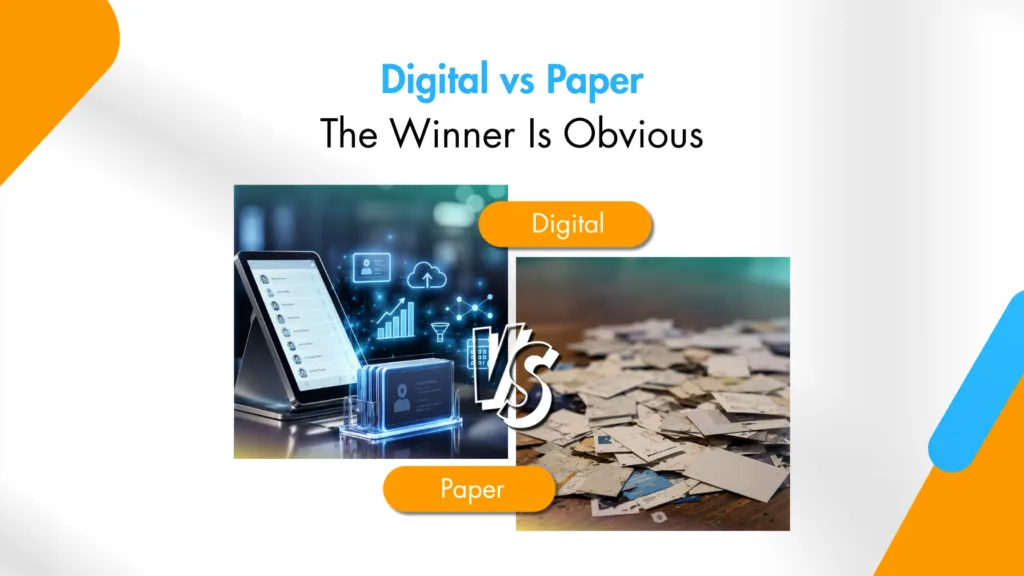
Digital vs Paper Lead Capture: A Practical Comparison
The debate between paper and digital is not about whether one can capture contact information and the other cannot. Both methods achieve that objective.
The real difference lies in what happens after the conversation ends.
To understand the impact on modern trade show networking, it is helpful to compare both approaches across the factors that influence lead quality, follow up speed, collaboration, and long term relationship management.
| Evaluation Factor | Paper Lead Capture | Digital Lead Capture |
| Initial Capture Speed | Quick exchange of business cards | Instant scan and automatic capture |
| Data Entry | Manual and time-consuming | Automated |
| Accuracy | Depends on manual transcription | High accuracy through scanning and AI extraction |
| Follow Up Readiness | Requires additional processing | Ready for immediate action |
| Note Taking | Separate notebooks or paper forms | Stored directly with contact records |
| Searchability | Difficult, especially at scale | Instant search across all contacts |
| Accessibility | Limited to the person holding the card | Accessible from anywhere |
| Team Collaboration | Requires manual sharing | Easily shared across teams |
| CRM Integration | Manual upload required | Seamless integration with workflows |
| Multilingual Support | Manual translation and entry | Supported through multilingual business card scanner technology |
| Scalability | Becomes difficult with large volumes | Designed for high volume events |
| Lead Qualification | Usually completed later | Captured during the interaction |
| Reporting & Analytics | Limited visibility | Detailed tracking and insights |
| Long Term Contact Management | Physical storage required | Organized digital database |
| Overall Event ROI | Difficult to measure accurately | Easier to track, manage, and optimize |
| Best For | Small events and occasional networking | Trade shows, conferences, and high volume networking |
Reference Table : 1 : Digital vs Paper Lead Capture: A Practical Comparison
While the comparison provides a useful overview, each factor affects event performance in different ways. The following sections explore the most important differences in greater detail and explain why many organizations are moving toward digital lead capture solutions.
1. Speed of Capture
Paper may seem fast because exchanging a business card takes seconds. However, the real work begins after the event when contacts must be entered into systems and follow up tasks created.
Modern event lead capture software eliminates much of this effort by capturing, organizing, and storing information instantly.
2. Information Accuracy
One of the most overlooked aspects of lead capture is data accuracy. Paper itself is accurate because the information is printed directly on the card. The challenge occurs during transcription. Manual data entry introduces errors. Names may be misspelled. Phone numbers may be entered incorrectly. Important details can be missed entirely. Digital systems reduce this risk by extracting information directly from the source.
While no technology is perfect, modern scanning tools significantly reduce the volume of human error associated with manual entry.
For organizations managing large numbers of contacts, this improvement alone can save considerable time and effort.
3. Context Retention
A business card answers one question exceptionally well: Who did you meet? What it rarely answers is:
- What was discussed?
- What challenges did they mention?
- What solutions interested them?
- What follow up was agreed upon?
These details are often captured separately on paper notes, notebooks, or memory.
As time passes, context fades. Digital lead capture allows professionals to record notes immediately alongside contact information, preserving the details that make follow up meaningful.
In many cases, the conversation itself is more valuable than the contact information.
4. Accessibility and Mobility
Paper is inherently limited by location. A business card collected at an event in Singapore remains wherever the card is stored. If a colleague in New York or London needs that information, someone must manually share it. Digital contacts are available wherever they are needed. For organizations operating across multiple offices, regions, or countries, accessibility becomes a significant advantage. This is particularly important for founders, global sales teams, consultants, and professionals who travel frequently between events.
5. Searchability
Imagine attending trade shows for three years and collecting 2,000 business cards.
Now try finding: “The technology director from Munich who wanted to discuss distribution opportunities.” With paper, this process could take hours. With digital systems, it takes seconds.
Searchability is one of the most underappreciated benefits of digital lead capture because its value compounds over time. The larger your network becomes, the more important searchable information becomes.
6. Team Collaboration
Business cards often remain with the person who collected them. Digital systems create visibility across sales, marketing, and leadership teams.
7. Scalability
Paper performs reasonably well at low volumes. Managing twenty business cards from a local networking event is straightforward. Managing hundreds of contacts across multiple international events is considerably more difficult. As event participation increases, manual processes become harder to maintain. Digital systems are designed to scale.
Whether capturing ten contacts or ten thousand, the process remains consistent and organized.
The Verdict at a Glance
| If Your Priority Is… | Recommended Approach |
| Simple one off networking | Paper |
| Faster follow ups | Digital |
| Managing hundreds of contacts | Digital |
| Team collaboration | Digital |
| CRM readiness | Digital |
| Global trade shows | Digital |
| Event ROI tracking | Digital |
| Long term relationship management | Digital |
For professionals attending occasional local networking events, paper may still provide a simple and familiar solution. However, as networking becomes more global, collaborative, and data driven, the advantages of digital lead capture become increasingly difficult to ignore.
The Global Networking Challenge
International trade shows introduce another challenge that traditional paper workflows were never designed to address. Business cards today are printed in multiple languages and formats.
A sales professional attending events across Asia, Europe, and the Middle East may receive cards containing different character sets, languages, and layouts. Manual transcription becomes increasingly difficult under these circumstances. This is why the demand for a multilingual business card scanner continues to grow.
The ability to accurately capture information from business cards across different languages allows organizations to maintain consistency while reducing administrative effort.
For globally active professionals, multilingual support is no longer a niche requirement. It is becoming a standard expectation.
Why the Best Business Card Scanner App Is More Than a Scanner
Trade shows are increasingly international. Professionals often receive business cards in multiple languages and formats, making manual data entry both time consuming and error prone.
This is where finding the best business card scanner app with multilingual capabilities becomes particularly valuable. By accurately extracting information from cards across different languages, organizations can reduce administrative effort while maintaining consistency.
For global sales teams and frequent travelers, multilingual support is becoming a necessity rather than a luxury.
From Lead Capture to Lead Management
One of the biggest mistakes organizations make is treating lead capture and lead management as separate activities. Capturing information is only the beginning. The real objective is ensuring that every conversation has a clear path forward. This is where leads management software for events plays an important role.Effective lead management allows organizations to:
- Prioritize opportunities
- Assign ownership
- Schedule follow ups
- Track engagement
- Measure event performance
- Improve conversion outcomes
Without a structured process, even the most successful event can produce disappointing results.
Where AI CardVault Fits Into the Modern Workflow
The evolution from paper to digital is not simply about replacing business cards. It is about creating a better system for managing professional relationships.AI CardVault was built with this reality in mind.
Rather than functioning solely as a scanning tool, AI CardVault combines intelligent contact capture, multilingual support, organization, and accessibility into a single platform.
Professionals can instantly digitize business cards, preserve meeting context, organize contacts, and access information whenever it is needed.
For founders, sales representatives, marketers, consultants, and frequent business travelers, this creates a more reliable way to manage connections long after the event has ended.
Conclusion
Paper lead capture earned its place in business because it was simple, familiar, and effective for its time. But the demands of modern networking have changed. Today’s trade shows generate larger volumes of contacts, involve more international interactions, and require faster follow up than ever before.
When evaluated across speed, accessibility, searchability, collaboration, scalability, and long term relationship management, digital lead capture offers clear advantages for modern professionals. The question is no longer whether digital tools can replace paper.
The question is whether organizations can afford to rely exclusively on paper in a business environment that increasingly rewards speed, organization, and accessibility.
As networking continues to evolve, the companies that capture, organize, and act on information most effectively will be the ones that generate the greatest value from every event they attend.
Frequently Asked Questions
Paper lead capture still has its place for simple, one-off, or small local networking events where volumes are low and follow-up is manageable. However, for modern trade shows — which are larger, faster, and more global — paper falls short. The core problem isn’t the initial exchange of a business card; it’s everything that comes after: manual data entry, transcription errors, limited searchability, and slow follow-up. For high-volume events and teams that need quick action on leads, digital tools offer clear advantages.
The main drawbacks show up after the event ends. Manual data entry is time-consuming and error-prone — names get misspelled, phone numbers get entered incorrectly, and important context from conversations is often lost entirely. Business cards also stay with whoever collected them, making team collaboration difficult. At scale (say, hundreds of contacts across multiple events), paper simply becomes unmanageable. There’s also no easy way to search, prioritize, or track leads without building out additional processes from scratch.
Digital tools capture and organize contact information instantly, so leads are ready for action right after — or even during — the event, rather than days later after manual processing. Professionals can also log conversation notes directly alongside contact records, preserving the context (challenges mentioned, solutions discussed, agreed next steps) that makes follow-up meaningful. This combination of speed and context leads to more relevant, timely outreach and ultimately better conversion outcomes.
International trade shows mean professionals regularly receive business cards printed in different languages, scripts, and formats — from Japanese kanji to Arabic to Cyrillic. Manual transcription of these cards is slow, difficult, and highly prone to errors. A digital lead capture tool with multilingual scanning support can accurately extract contact information regardless of the language or format, keeping data consistent and reducing administrative burden. For globally active sales teams and frequent business travelers, this capability has shifted from a nice-to-have to a practical necessity.