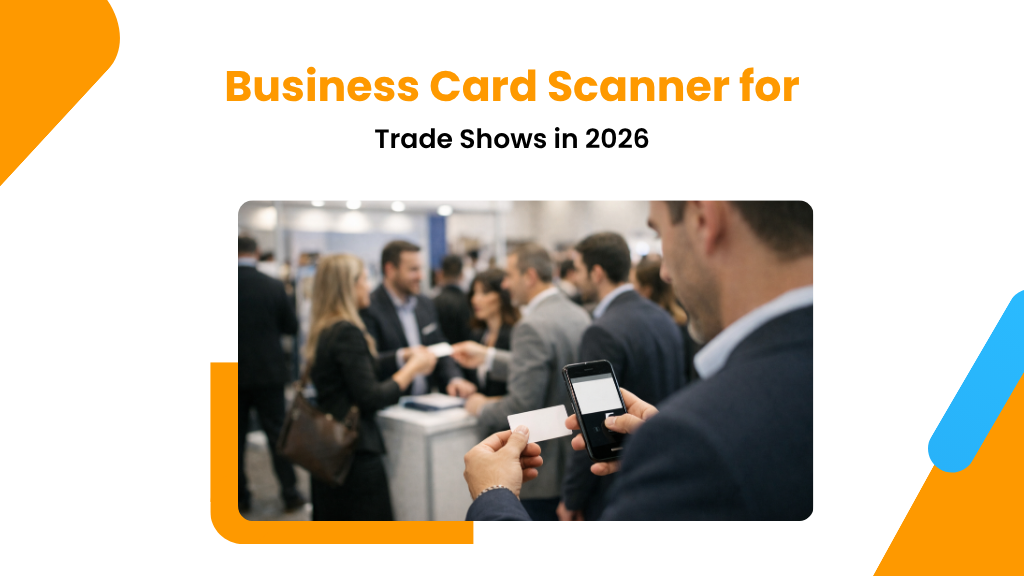


Introduction: Why Choosing the Right Scanner Matters More Than Ever in 2026
Trade shows have always been a high-intent environment for business conversations, but the way leads are captured and managed has not kept pace with how fast these interactions now happen. Conversations are shorter, expectations are higher, and the window to convert a meaningful interaction into a real opportunity has narrowed.
In this setting, choosing the best business card scanner app is no longer a convenience decision. It directly influences how efficiently teams capture leads, how accurately they retain context, and how quickly they can act on opportunities once the event ends. What used to be a simple act of digitizing contact details has become a critical part of the lead capture and conversion process.
The difference between tools in 2026 is not minor. It is structural. Some tools store information, while others help teams move from conversation to conversion without friction.
The Real Challenge: Why Most Trade Show Leads Never Convert
Despite the volume of leads collected at trade shows, a large percentage never translates into meaningful outcomes. This is not due to lack of effort during the event, but because of what happens afterward.
When leads are captured without context, follow-ups become generic. When data is disorganized, prioritization becomes difficult. When there is a delay between capturing a contact and acting on it, the intent behind the interaction fades quickly.
Many teams assume the problem lies in lead generation. The real gap exists in lead handling. Capturing a business card is only the starting point. Without structure, clarity, and readiness for follow-up, even high-quality interactions lose momentum.
This is where the choice of a business card scanner becomes important. The right tool does not just collect data; it preserves intent and prepares it for action.
Why Traditional Business Card Scanners Fail at Trade Shows
Many business card scanner apps available today were not designed for trade show environments. While they work well in controlled settings, they struggle in event-based, high-volume situations where speed and accuracy must work together without disrupting conversations.
Traditional tools are built around digitization. They scan, extract, and store contact details, but they do not go further. In a trade show setting, this creates a gap, since capturing contact information alone is not enough. Teams also need context, structure, and immediate usability within their sales workflows.
In practice, these limitations become clear:
- They rely on ideal conditions, which rarely exist at events
- Inconsistent lighting, varied card designs, and quick interactions reduce OCR accuracy
- They do not capture context such as notes, intent, or conversation details
- There is no support for real-time lead structuring or prioritization
- CRM integration is often limited, which delays follow-ups
- Workflows involve manual corrections and fragmented data handling
Instead of simplifying lead capture, these tools introduce friction at the point where efficiency matters most. This gap between trade show needs and tool capabilities leads to lost value, even when teams use digital solutions.
What Has Changed in 2026: From Scanning Cards to Capturing Intelligence
The role of business card scanners has shifted from simple data capture to intelligent lead management. Advances in AI-powered OCR business card scanning and the need for real-time decision-making in sales environments drive this change.
Modern solutions do more than extract text. They structure information, identify relevant fields, and organize leads in a way that matches how teams work. This includes categorization, tagging, and preparing data for direct use in CRM systems.
In practical terms, this shift includes:
- Structuring and organizing contact data automatically
- Enabling real-time categorization and tagging
- Preparing data for immediate CRM integration
- Extracting information with minimal manual input
- Aligning lead capture with actual sales workflows
The focus has moved from “How quickly can this card be scanned?” to “How ready is this lead for follow-up the moment it is captured?”
This marks a move from passive data collection to active lead capture, where speed, structure, and usability work together.
How to Choose the Right Business Card Scanner for Trade Shows
Selecting the right business card scanner requires evaluating how tools perform in real trade show conditions rather than how they appear in feature lists. The following criteria provide a practical way to make that decision.
Speed and Real-Time Capture in Fast-Paced Environments
Trade shows operate on momentum. Conversations are brief, and opportunities move quickly. A scanner that slows down interaction or requires multiple steps reduces the number of meaningful connections a team can handle.
The right approach ensures that contact details, context, and notes are captured together in one flow, without interrupting the conversation. This is where a system designed for real-time capture makes a measurable difference.
OCR Accuracy in Imperfect Conditions
Accuracy is tested in real environments where lighting, angles, and card quality vary. A reliable business card scanner maintains high accuracy even under these conditions.
AI-powered OCR plays a key role by ensuring extracted data is clean, structured, and usable without manual correction. This reduces the need for rework and keeps the focus on engagement rather than data cleanup.
AI Capabilities Beyond Basic Scanning
Digitization alone is not enough. The ability to categorize, tag, and organize contact data determines how useful it becomes after the event.
Choosing an AI-powered business card scanning platform ensures that information is structured as it is captured, helping teams prioritize leads and maintain clarity without additional effort.
CRM Integration and Instant Synchronization
Captured data only has value when it can be used immediately. Tools that require manual export create delays and increase the risk of missed opportunities.
A system that connects directly with CRM workflows ensures that leads are available for action without extra steps, reducing lag between interaction and follow-up.
Offline Functionality for Event Environments
Connectivity at large trade shows is often unreliable. A tool that depends entirely on internet access can become ineffective at critical moments.
Offline capability ensures that lead capture continues without interruption, with data syncing once connectivity is restored.
Lead Organization and Searchability
Capturing a large number of leads is useful only if they can be accessed and managed easily. Structured data and search functionality make this possible.
When information is organized at the point of capture, teams spend less time sorting and more time acting on opportunities.
Follow-Up Readiness as a Core Requirement
The purpose of capturing leads is to enable meaningful follow-up. A system that prepares data with context, notes, and structure creates a clear advantage.
When leads are ready for action immediately, response time improves and conversion opportunities increase.
Common Mistakes When Choosing a Business Card Scanner
Choosing a business card scanner is often treated as a feature comparison exercise, which leads to decisions that do not hold up in real usage. Many teams focus on surface-level aspects without considering how the tool fits into their workflow.
These mistakes often appear as:
- Prioritizing interface design over workflow compatibility
- Ignoring post-event processes such as organization and follow-up
- Choosing tools that work during scanning but not after
- Overlooking the importance of structured data and context
- Selecting solutions focused only on digitization
The real difference lies in whether the tool supports action, not just storage.
What High-Performing Teams Do Differently at Trade Shows
High-performing teams treat lead capture as part of their sales process. They focus on capturing both contact details and context.
They structure data during the event and prioritize leads based on intent. This allows them to act quickly while the interaction is still fresh.
This approach reduces delays and improves conversion outcomes.
What the Ideal Business Card Scanner Looks Like in 2026
An effective solution combines speed, accuracy, and intelligence without adding complexity. It works in the background, allowing users to focus on conversations while ensuring that all relevant information is captured and organized.
This approach is reflected in how AI CardVault is designed — where lead capture, organization, and readiness for follow-up are connected in a single flow rather than treated as separate steps.
Such a system keeps pace with real-time interactions, reduces manual work, and prepares leads for immediate use across teams.
Why Most “Best Business Card Scanner Apps” Lists Miss the Point
Many comparison articles rank tools based on features or pricing while ignoring usage context.
A tool that performs well in a controlled setting may not work the same way in a trade show environment. Decisions based only on features often fail in practice.
A Smarter Approach to Trade Show Lead Capture
A more effective approach is to move beyond standalone tools and adopt a system built around a structured trade show lead capture workflow — one designed specifically for how leads are captured and used in real trade show environments.
This means capturing information instantly, structuring it with context, and making it ready for action without additional effort after the event.
This is how AI CardVault is built.
Instead of treating business card scanning as a separate task, it connects the full process — from capturing contact details to organizing leads and preparing them for follow-up. Information is structured at the point of interaction, reducing the need for manual cleanup and eliminating delays.
Conclusion: The Right Choice Is the One That Drives Conversion
Choosing the right business card scanner for trade shows in 2026 is about selecting a system that aligns with how your team captures and uses leads in real time.
The right choice reduces friction, preserves context, and enables faster follow-up. These factors directly influence outcomes.
Success at trade shows is not defined by how many cards are collected, but by how many conversations turn into real opportunities.
Frequently Asked Questions
This section covers a broad range of topics as a valuable resource for clients, providing them with quick and easy access to information that can help them make informed decisions about AI CardVault
The problem usually isn’t lead generation — it’s lead handling. When leads are captured without context, follow-ups become generic. When data is disorganized, prioritization is hard. And when there’s a delay between capturing a contact and acting on it, the original intent behind the interaction fades quickly.
Traditional scanners were built for controlled environments, not busy event floors. They struggle with inconsistent lighting, varied card designs, and quick interactions. They capture contact information but don’t record context, notes, or intent. They also lack real-time lead structuring, have limited CRM integration, and often require manual corrections — all of which add friction at the worst possible moment.
Evaluate tools on these criteria:
- Speed — captures contact details and notes in one uninterrupted flow
- OCR accuracy — performs reliably under poor lighting and varied card designs
- AI capabilities — categorizes and tags leads automatically, not just digitizes
- CRM integration — syncs data instantly without manual export steps
- Offline functionality — works even when event Wi-Fi is unreliable
- Lead organization — makes captured leads searchable and easy to manage
- Follow-up readiness — preserves context so outreach can begin immediately
It combines speed, accuracy, and AI-driven intelligence without adding complexity. It works in the background while the user stays focused on the conversation, and it connects lead capture, organization, and follow-up readiness into a single seamless flow — rather than treating them as separate steps.