

Introduction: The Reality of Global Networking
Most business cards are simple. They follow a simple structure, use a single language, and are easy for scanning tools to process. This is exactly the environment traditional OCR-based card scanners were built for.
However, global business interactions rarely stay within those boundaries.
At international conferences, cross-border meetings, or global partnerships, professionals often exchange business cards designed for more than one audience. These cards may include multiple languages, different scripts, or region-specific formats. They are not common. But when they appear, they are usually tied to high-value interactions.
And this is where traditional card scanners begin to fail.
Multilingual Business Cards: Rare but High-Impact
Multilingual Business card scanning app are typically created for clarity across markets. A professional working across regions may include English alongside another language to ensure accessibility and credibility in different contexts.
For example, a single card may present the same details in English and Chinese, or English and Arabic. In some cases, regional languages are included alongside global ones.
These cards are not designed for machines. They are designed for humans.
A human reader can easily understand that the same information is being repeated in another language. They can distinguish between name, designation, and company, even when the layout varies.
Traditional scanners cannot.
What Makes Multilingual Business Cards Difficult to Process
The challenge is not just language. It is structured. Multilingual cards often combine multiple scripts, visual separations, and repeated information across sections. The same name may appear in two different formats. Titles may be positioned differently depending on the language. Layouts are often designed for visual balance rather than machine readability. This creates ambiguity.
For a scanner that relies on pattern recognition rather than understanding, ambiguity leads to incorrect extraction.
How Traditional Card Scanners Work
Traditional business card scanners are built on OCR technology that focuses on detecting characters from images and converting them into text. This process works effectively under controlled conditions:
- one language
- consistent font styles
- predictable layouts
- clear separation of fields
However, OCR does not understand context. It does not know which text represents a name, a company, or a designation unless it follows familiar patterns. It reads characters. It does not interpret the meaning. As long as the input matches its expectations, it performs well. Once those expectations are broken, accuracy drops.
Where Traditional OCR Breaks Down
Multilingual business cards introduce conditions that traditional OCR systems are not equipped to handle.
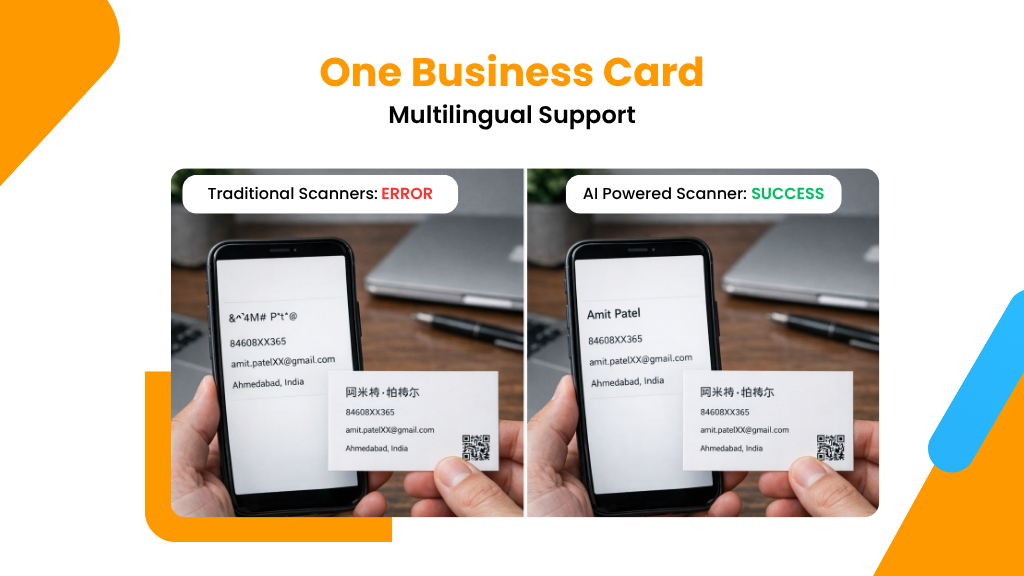
When multiple languages appear on a single card, the system often fails to identify which language model to apply. It may process all text as one language, resulting in distorted outputs.
Different scripts add another layer of complexity. Latin alphabets, Chinese characters, Arabic scripts, and Indic languages all follow different structural rules. A scanner trained primarily on one system cannot reliably interpret another.
Layout also becomes a challenge. Many multilingual cards separate languages into different sections or layers. Without an understanding of structure, the scanner may combine unrelated elements or split connected information.
Field mapping becomes unreliable as well. Even if the text is captured correctly, assigning it to the right category becomes difficult. Names may be tagged as companies. Titles may be ignored. Contact details may be fragmented.
The Real-World Impact of These Failures
These are not minor inconveniences. Inaccurate data directly affects business outcomes.
A misinterpreted email address leads to failed communication. A distorted name creates confusion. Missing designations remove important context about a contact’s role.
In global networking, where interactions are often brief and follow-ups are critical, there is limited room for error. One incorrect scan can result in a missed opportunity.
Common Errors in Multilingual Card Scanning
When traditional scanners process multilingual cards, certain patterns of errors frequently appear.
Names written in non-Latin scripts are often partially captured or incorrectly converted. Company names may be split across fields or merged with unrelated text. Contact details such as phone numbers or email addresses may be misplaced or lost entirely.
These errors are not always obvious at first glance. They often surface later, when the data is used.
Why Accuracy Matters More in International Contexts
In local settings, errors can often be corrected quickly. A follow-up message or a second interaction can resolve missing information.
In international business, this is not always the case.
You may not have immediate access to the person again. Time zones, communication barriers, and limited interaction windows make accuracy at the point of capture essential. Reliable data becomes the foundation for maintaining the connection.
How AI-Based Scanning Approaches the Problem Differently
Modern AI-powered systems address these challenges by moving beyond basic character recognition.
Instead of focusing only on text, they analyze structure, context, and relationships between elements on the card.
This allows them to identify multiple languages within the same image, process different scripts simultaneously, and understand how information is organized.
More importantly, they interpret meaning. They can distinguish between a name and a company, even when the layout is unfamiliar. They can map fields based on context rather than fixed patterns.
This shift from recognition to understanding significantly improves accuracy.
What to Look for in a Multilingual Card Scanning Solution
For businesses that operate across regions, choosing the right scanning tool is critical.
A reliable solution should support multiple languages and scripts, handle varied layouts, and accurately map extracted data into structured fields. It should also integrate seamlessly with CRM systems to ensure that captured data is immediately usable.
Without these capabilities, inconsistencies in data will continue to create friction in workflows.
How AI CardVault Handles Multilingual Business Cards
AI CardVault is built specifically for real-world networking scenarios where data is not always clean or predictable.
It is designed to process multilingual business cards by recognizing multiple languages within a single scan and understanding the context in which information appears. Instead of relying on rigid patterns, it adapts to different layouts and scripts, ensuring that names, roles, and contact details are captured accurately.
The result is accurate contact data that can be used immediately without manual correction.
Conclusion: Accuracy Defines the Value of a Connection
Multilingual business cards may not be common, but they represent some of the most important connections in global business.
Traditional scanners, built for simpler use cases, are not equipped to handle this complexity.
As business interactions continue to expand across regions and languages, the ability to capture accurate contact data becomes increasingly important.
Because in the end, the value of a connection depends on how well it is preserved.
Frequently Asked Questions
This section covers a broad range of topics as a valuable resource for clients, providing them with quick and easy access to information that can help them make informed decisions about AI CardVault
A multilingual business card scanning app uses AI to detect and process multiple languages within a single card. Instead of treating all text the same, it understands context, separates repeated information, and accurately maps details like name, company, and designation—even across different scripts.
Traditional scanners rely on basic OCR, which only reads characters without understanding meaning. When a card includes multiple languages or complex layouts, the system cannot correctly interpret structure, leading to errors in extracted data.
When choosing a business card scanning app, look for features like multilingual support, AI-based data extraction, accurate field mapping, and CRM integration. These ensure that contact details are captured correctly and can be used instantly without manual correction.
AI-powered trade show lead capture software analyzes context, layout, and relationships between text elements instead of just recognizing characters. This allows it to accurately capture multilingual data, reduce errors, and ensure reliable contact information for follow-ups.