

Quick Overview
This blog explains how small errors in business card scanning—such as incorrect emails or phone numbers—can silently disrupt follow-ups and CRM workflows. It highlights the operational and financial impact of inaccurate contact data and how AI-powered OCR improves accuracy compared to manual entry or traditional OCR tools.
Introduction: When a Small Data Error Becomes a Lost Opportunity
Trade shows, conferences, and networking events remain one of the most effective ways for sales teams to generate new leads. Conversations happen quickly, connections are made in person, and business cards are exchanged as the first step toward future opportunities.
But the real value of those interactions is realized after the event, when the contact information is transferred into the company’s CRM and follow-ups begin. This is where a surprisingly small problem can create a much larger one.
A single typo in an email address, a missing digit in a phone number, or an incorrectly captured company name can prevent a lead from ever receiving a follow-up message. The sales team assumes outreach was sent, the CRM record appears complete, and yet the opportunity quietly disappears.
For organizations that rely on event-driven lead generation, contact data accuracy is not just a data management issue, it directly affects revenue outcomes.
This is where an AI-powered business card scanning software like AI CardVault helps ensure that contact data captured at events is accurate and ready for CRM follow-ups.
Why Accurate Contact Data Is Critical for Sales Teams
Sales pipelines depend on timely and reliable communication. After an event, the first follow-up email often determines whether a conversation turns into a meaningful business opportunity.
Accurate contact data enables sales teams to:
- Send immediate post-event follow-ups
- Assign leads to the correct representatives
- Track engagement history within the CRM
- Segment prospects for targeted campaigns
- Maintain consistent communication across channels
When contact information is inaccurate, these processes break down, Emails bounce, and phone numbers fail. Leads are misassigned or lost within the CRM. Sales teams spend valuable time correcting records instead of building relationships with prospects. Accurate contact data allows sales teams to perform timely post-event follow-up, which often determines whether event conversations convert into real opportunities.
Over time, poor data quality reduces the effectiveness of both sales and marketing efforts.
Common Errors in Business Card Data Capture
Despite advances in digital tools, capturing business card information accurately remains challenging. Several types of errors frequently occur when contacts are digitized.
1. Typographical Errors
Manual data entry often leads to simple mistakes, such as:
- Misspelled names
- Incorrect email domains
- Missing phone digits
- Mis-typed company names
Even minor inaccuracies can make it impossible to reach a prospect.
2. Field Misinterpretation
Business cards vary widely in design. Information may appear in different layouts, font styles, or visual structures.
As a result, scanning tools sometimes misidentify which text belongs to which field. For example:
- Job titles may be captured as company names
- Phone numbers may be mistaken for fax numbers
- Multiple numbers may be merged incorrectly
3. Duplicate Contact Records
When contact information is entered multiple times by different team members, duplicate records appear in the CRM.
This creates fragmented communication histories and reduces the reliability of sales data.
How Poor Data Quality Impacts CRM and Sales Follow-Ups
CRM platforms are designed to centralize customer interactions and help sales teams manage opportunities effectively. However, their value depends entirely on the quality of the data they contain.
When inaccurate contact data enters the CRM, several operational problems arise.
- Failed Outreach – Incorrect email addresses or phone numbers prevent successful communication with prospects.
- Delayed Follow-Ups – Sales representatives often need to manually verify contact information before initiating outreach, slowing down the follow-up process.
- Misrouted Leads – Incorrect company names or job titles may cause leads to be assigned to the wrong teams or territories.
- Reduced Sales Productivity – Instead of focusing on building relationships and closing deals, sales teams spend time cleaning up inaccurate data.
Across multiple events and campaigns, these inefficiencies accumulate and weaken the effectiveness of the sales pipeline. In a well-designed trade show lead capture workflow, contact data is captured, enriched, and synced to the CRM without delays or manual corrections.
The Hidden Business Cost of Incorrect Contact Data
The impact of inaccurate contact data extends beyond operational inconvenience. It has real financial consequences.
Consider a company that participates in several industry events each year and collects hundreds of business cards at each event. If even 10–15% of captured contacts contain errors, a significant number of potential opportunities may never enter the sales funnel.
The hidden costs include:
- Lost revenue from missed follow-ups
- Additional administrative effort to correct CRM records
- Lower conversion rates from event-generated leads
- Reduced confidence in internal sales data
Over time, these issues reduce the return on investment from events and networking initiatives. When inaccurate contact data prevents follow-up outreach, the impact goes beyond operational inefficiency and directly affects trade show ROI.
Why Traditional Scanning Methods Struggle with Accuracy
Organizations evaluating the best business card scanner apps often discover that AI-driven platforms provide higher accuracy and better CRM integration compared to traditional OCR tools.
While OCR can identify text from images, it has limitations when interpreting complex card layouts. Modern solutions using AI-powered OCR Business Card Scanning significantly improve how contact information is extracted and structured.
Several factors affect its accuracy.
- Complex Card Designs – Modern business cards often include logos, creative typography, and unconventional layouts. Traditional OCR systems may capture the text but fail to assign it to the correct fields.
- Global Contact Formats – International events introduce business cards with different phone number formats, languages, and address structures. Basic OCR tools often struggle to interpret these variations.
- Continued Dependence on Manual Editing – Because traditional OCR cannot fully understand context, users frequently need to review and correct extracted data manually.
This reduces efficiency and reintroduces the risk of human error.
AI OCR vs Manual Data Entry: Which Is More Accurate?
Recent advances in artificial intelligence have significantly improved the accuracy of business card scanning.
Unlike traditional OCR systems, AI-powered OCR combines text recognition with contextual understanding, allowing it to interpret the structure of business cards more effectively.
1. Advantages Over Manual Entry
- Manual data entry is highly susceptible to human error, especially when sales teams process large volumes of cards after events.
- AI systems reduce these risks by automatically extracting and structuring the data.
2. Context-Aware Data Extraction
- AI models analyze relationships between text elements on the card, enabling them to correctly identify names, companies, job titles, phone numbers, and email addresses.
3. Pattern Recognition and Validation
- AI can recognize common data patterns such as email structures, phone number formats, and website URLs, helping prevent incorrect entries.
4. Continuous Learning
- AI systems improve over time as they process more cards, adapting to new layouts and formats.
As a result, AI-powered scanning solutions typically achieve significantly higher data accuracy compared to manual entry or traditional OCR tools.
How AI CardVault Helps Maintain Clean and Accurate Contact Data
AI CardVault was designed to address the data accuracy challenges that arise during event networking and lead capture.
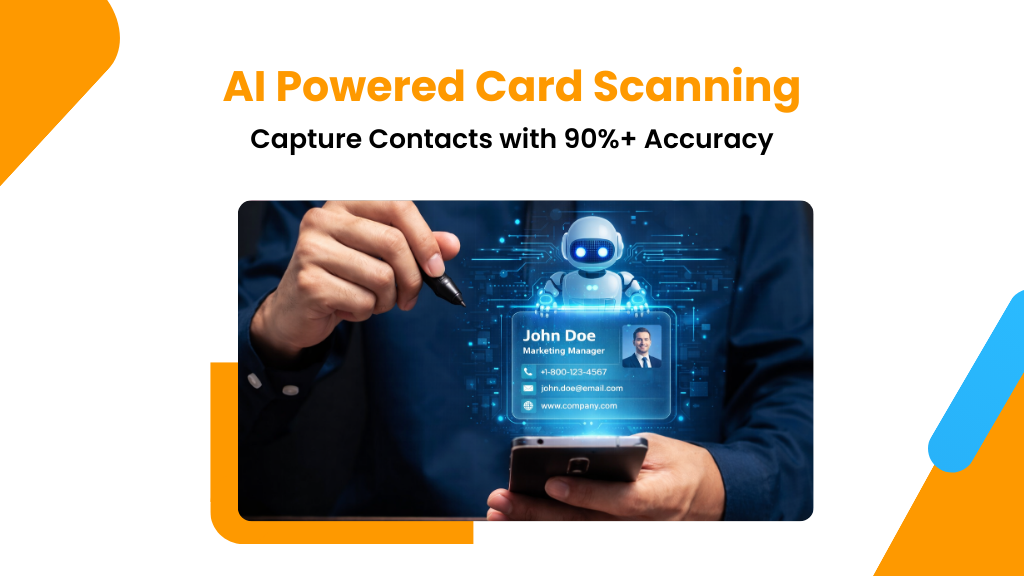
Using advanced AI-powered OCR technology, the platform extracts business card information and converts it into structured, CRM-ready contact records.
Key capabilities include:
- Intelligent identification of names, job titles, companies, and contact details
• Automatic structuring of contact data for CRM integration
• Fast mobile-based scanning during events
• Reduced need for manual corrections
• Improved accuracy in contact capture workflows
By ensuring that contact information is captured correctly from the beginning, AI CardVault helps sales teams focus on building relationships and advancing opportunities rather than correcting CRM data.
Conclusion: Accurate Data Is the Foundation of Successful Follow-Ups
In Revenues and sales operations, accurate contact data plays a critical role in maintaining an effective pipeline. Manual data entry introduces human errors, while traditional scanning tools often struggle with complex card layouts and contextual interpretation.
AI-powered OCR represents a significant advancement in contact capture technology. By combining character recognition with contextual understanding and pattern validation, AI systems dramatically improve the accuracy of business card digitization.
For organizations that rely on event-based lead generation, this improvement is substantial.
When contact data is accurate, follow-ups happen faster, CRM records remain reliable, and valuable connections made at events are far more likely to turn into real business opportunities.
frequently asked questions
This section covers a broad range of topics as a valuable resource for clients, providing them with quick and easy access to information that can help them make informed decisions about AI CardVault
Accurate contact data ensures that sales teams can successfully follow up with leads after events. When business card scanning captures accurate contact data, emails reach the right prospects, CRM records remain reliable, and valuable opportunities are not lost due to simple data errors.
When business card scanning captures inaccurate contact data, emails may bounce, phone numbers may fail, and leads may be misassigned in the CRM. These errors delay follow-ups and reduce the chances of converting event conversations into real sales opportunities.
AI-powered OCR improves accurate contact data extraction by recognizing patterns such as email formats, phone numbers, and company names. This contextual understanding helps AI systems capture accurate contact data more reliably than manual entry or traditional OCR tools.
Businesses can ensure accurate contact data by using AI-powered business card scanning tools that automatically extract and structure contact details. These tools reduce manual errors, organize contacts instantly, and make the data CRM-ready for faster follow-ups.